
Unveiling the Trinity with the Triangle Pose Trikonasana
Trikoṇāsana (त्रिकोणासन)

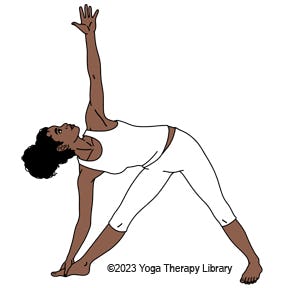
triangle pose yoga therapy library image
Unveiling the Trinity with the Triangle Pose Trikonasana
Trikoṇāsana (त्रिकोणासन)
Trikoṇāsana, Triangle Pose, is a potent Yoga asana with profound symbolic resonance. The classic standing pose offers an opportunity to delve into the beauty of balance and harmony, uniting body, mind, and spirit in a stance of strength and flexibility. Trikoṇāsana speaks to us of sacred trinities and inherent unity, inviting us to experience our interconnectedness in a tangible, physical form.
Symbolism of Trikoṇāsana
Trikoṇāsana is imbued with the symbolism of the sacred trinity, represented in various ways such as mind, body, and spirit; past, present, and future; and power, harmony, and prosperity. These triads speak to the fundamental interconnectedness of all aspects of existence.
Cultural Appreciation
The asana is also reminiscent of the Trimūrti, the Hindu Trinity consisting of Brahma (creator), Vishnu (preserver), and Siva (destroyer). Though they are separate divinities, they work in harmony to uphold order in the universe, reflecting the harmony we seek in our personal lives and yoga practice.
Benefits of Trikoṇāsana
The Triangle Pose offers multiple benefits:
- Strengthens and Tones: Triangle pose targets and strengthens a variety of muscles, particularly in the legs and core. It also helps to tone the hips and thighs.
- Enhances Balance and Focus: The pose challenges and improves balance, while the concentration required promotes mental clarity.
- Encourages Flexibility: It provides a stretch along the spine, chest, shoulders, and hamstrings, promoting overall flexibility.
Triangle pose invites engagement and lengthening of several muscle groups:
Engaged Muscles: Quadriceps, external obliques, gluteals, and deltoids are all activated to maintain the pose's alignment and stability.
Lengthened Muscles: Hamstrings, psoas, latissimus dorsi, and muscles of the rotator cuff are lengthened in this pose, contributing to flexibility and improved posture.
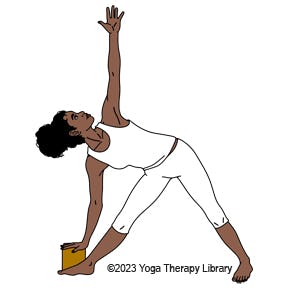
Triangle pose with block yoga therapy library image
Cuing text - using economy of words with personal pronouns:
- Stand tall, Your feet apart, wider than hip distance.
- Turn one of your feet out 90 degrees, turn in the opposite foot slightly, 15-45 degrees.
- Extend your arms to the sides, palms facing down.
- Reach out over the out-turned leg, the movement is of the rib cage and upper body sliding sideways.
- Bend at hip crease, and rotate your upper body toward your thigh, shin or foot, within your comfort range.
- Be sure to keep your upper body and front leg in the same plane.
- If it is comfortable for you, draw your chin in slightly and rotate your head to gaze up at your thumb.
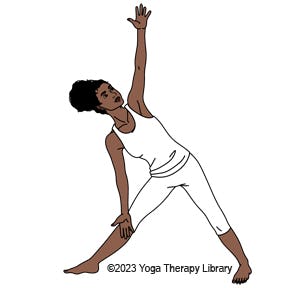
triangle pose yoga therapy library image
Variations for Accessibility
Variations for this pose make it more accessible for different body types and skill levels:
- Use a Block: Use a yoga block under your bottom hand for support.
Limit Range of Motion (ROM) of upper body, to keep your lower hand at knee level or higher. - Use a Chair: you may practice this pose siting in a chair, or standing chair side-use the back of the chair or the seat as a prop to rest your lower hand.
- Limit Range of Motion of neck if it is uncomfortable to look up or feels like too much strain; simply gaze straight ahead or downwards.
Cakras (Chakras) Influenced
Trikoṇāsana primarily stimulates the Svādhiṣṭhāna (Sacral or Second) Cakra and the Maṇipūra (Solar Plexus or Third) Cakra, fostering creativity, self-esteem, and personal power.
Dṛṣṭi - Drishti
The traditional dṛṣṭi, or focal point, for Trikonasana is towards the raised hand, or Haṃsa Dṛṣṭi. However, depending on comfort, practitioners can choose